


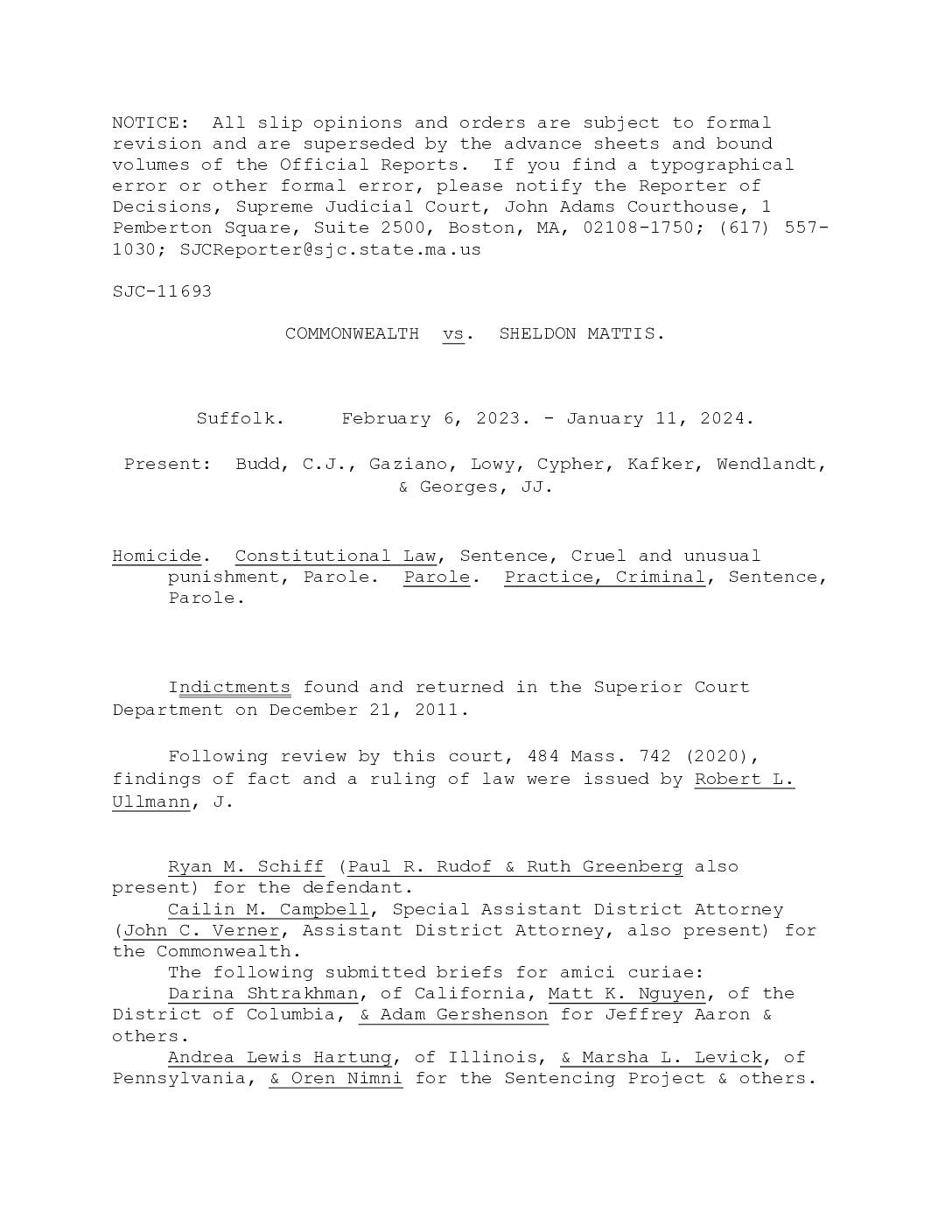
PDF Commonwealth v. Mattis
In this decision, the Massachusetts Supreme Judicial Court found life without the possibility of parole (LWOP) sentences to be unconstitutional under the Massachusetts Constitution for people who were 18 to 20 years old at the time of the crime. The Court further held that this applies retroactively, which means that people currently serving LWOP in Massachusetts who were 18 to 20 at the time of the crime will be eligible for parole consideration under the time-frames that apply to people who were under 18 at the time of the crime. Sentences for people who were under 18 at the time of the crime were changed on July 25, 2014, so qualifying individuals sentenced to LWOP prior to that date will be eligible for parole consideration after serving 15 years, while those sentenced after that date will be eligible after serving 20 to 35 years, depending on the specifics of the crime. The decision does not guarantee that they will be released; it simply provides them the opportunity to go in front of the parole board, show their rehabilitation, and demonstrate that they are ready to safely return to the community.
This decision was based in large part on a growing understanding of the science of adolescent brain development. The Court pointed to four specific ways in which emerging adults differ from older adults due to their not-fully-mature brains:
- Emerging adults are “less able to control their impulses in emotionally arousing situations” than older adults, and instead are more similar to 16 and 17 year olds in terms of impulse control.
- Emerging adults are “more prone to ‘sensation seeking,’ which includes risk-taking in pursuit of rewards,” in comparison to both older adults and younger teens.
- Emerging adults are “more susceptible to peer influence” than older adults.
Emerging adults “have greater capacity to change than older individuals because of the plasticity of the brain during these years.”